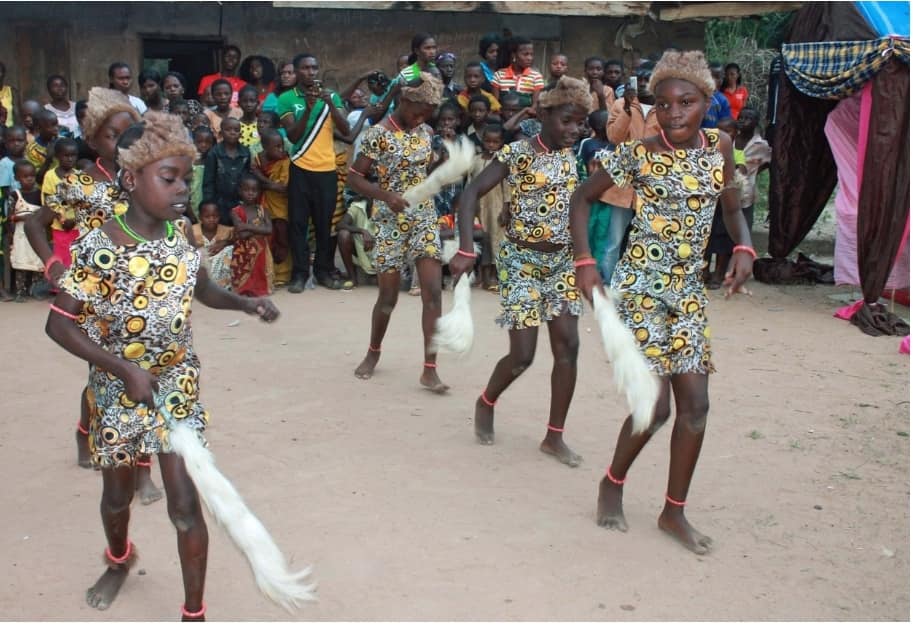

The present settlements of the Orring People of Ebonyi State are: Ntezi and Okpoto as found in Ishielu LGA; Effium in Ohaukwu; and Amuda and Okpomoro in the southern part of Ohaukwu. Ntezi is bordered in the north by Ngbo; in the south by Ezza; and in the east and west by Ezzamgbo and Ezillo, respectively.
Ntezi has five Oring-speaking villages, namely: Agaga, Ulepa, Iyokpa, Amata, and Biledeba. These villages are further made up of various hamlets, lineages called Lèmá, and farm settlements; there are also two villages, Umuezeka and Umuezekoha settlements, at the outskirts to the southwest and southeast of Ntezi, respectively.
The Orring people occupy scattered heterogeneous territories coexisting in three states in Nigeria, which are Benue, Cross River, and Ebonyi States. Orring people exist and settle alongside their counterparts' neighbours. This proximity has over the years led to some intergroup relationships through marriage, shared beliefs, and cultural exchanges, resulting in the creation of mixed civilizations that have resulted in a number of differences among the aborigines. This is the case for linguistic and cultural evidence among people.
Orring Cross River State has K'orring speakers; Ebonyi State has Ntezi, Okpoto, Amuda, Okpolo, and Effiom; and Benue State has Ukelle and Ufia.The Orring people are not linguistically and culturally distinct from the Ukelle people. Scholars believe that the Kukelle and Korring languages are dialect groups of the same language family, but that it could be a breakaway of one of the Igbiod dialects of the Niger-Cross Language family, of which the Igbo language is a member.This is particularly a result of the common names and terms among the Igbo hearthands and the Orring people.
The history of the Orring people is sketchy; however, some speculate that they descend from the Kwararafa kingdom before the amalgamation of Nigeria. However, oral tradition deems that Orring settled in present-day Ebonyi State prior to the coming of the Igboid sub-tribes of Ezza, Izzi, Ikwo, and Ngbo, whose progenitors migrated from the southern Igbo and Ibibio kingdoms of Aro, Afikpo, Edda, Nkwa, Abak, and Ohafia. This assertion is supported by historical documents of the Abakaliki people compiled by Abakaliki scholars. Years of intertribal warfare have resulted in the fragmentation and dispersal of Orring settlements.The Orring people were once settled in contiguous territories, including those of the Ba'kelle, Uffia, and Ba'humono, before being dislodged and separated by invading groups.
Orring people can also be found in Cross River's Yala LGA (also known as Ukelle or Ba'kelle) and Abi LGA (also known as Ba'humono), as well as Ado LGA (also known as Utonkon or Uffia) on the Benue state border.While some Orring people were early inhabitants of the Enugu-Abakaliki region and the upper Cross River in present-day South Eastern Nigeria, it is likely that the Orring group migrated from the Kwararafa federation due to Fulani jihads.
Prior to Colonialism, the Nigeria Civil War, and the present period, the Orring people of Ebonyi state simply identified with their counterparts as Igbo, bearing Igbo names and terms, cultural values, linguistic connectivity, and other identity factors. The average Orring person simply refers to themselves as Igbo and maintains a strong Igbo personality wherever they go.
Ntezi people are known for their masquerade festival known as "Oviode," a chief deity celebrated once every year after the showcase of the full moon. It is a very important celebration observed by the five villages of Ntezi. The Oviode Festival attracts tourists during the celebrations. There are other cultural festivals, but Oviode is the most popular. It usually takes place after the five villages have summed up their own individual celebrations, which are peculiar to the individual villages that make up the Ntezi community.
The Ntezi people are also known to be skilled crafters, with basket-making being a notable occupation among the people. Aside from farming and agriculture, trading is another important economic activity in Ntezi, with a relatively large and very busy Ode market that holds once every four Igbo market days. Ode Ntezi is a modern market located in the Ntezi community. a rural area in Ishielu LGA of Ebonyi State, Nigeria.
Ode drew its name from the Igbo "orie" market. The Koring dialect seems to be a sub-dialectal blend of Igbo, though very strong due to the presence of non-Igbo speaking groups prior to the state system in Nigeria, which was purely responsible for the presence of misconception among scholars today.
Ode Market is as old as Ntezi itself. Oral history holds that trade routes were established in the olden days to link up the "Br" salt factory with northern Igbo and Idoma traders. Ode Ntezi, as it is commonly known by traders and visitors, is a point for trading various wares and agricultural produce. Presently, the market is emerging as the biggest basket market in Nigeria.
Ntezi community, where the market is found, speaks Korring, a sub-Bantu language spoken in northern Cross River and also in Taraba and Benue states, Nigeria. The language is believed to be a descendant of the ancient Kwararafa confederation. Ntezi and other Korring-speaking people in Ebonyi State occupied the entire Abakaliki region prior to the coming of the Igbo-speaking people.
However, after centuries of transcultural relations with the Igbo people, Orring people are mostly integrated with Igbos in every aspect of their sociocultural lives. Hence, the Orring of Ebonyi are often considered to be Igbos. This scenario actually hinders relationships with other Orring and Ukelle groups who do not identify as Igbos.


